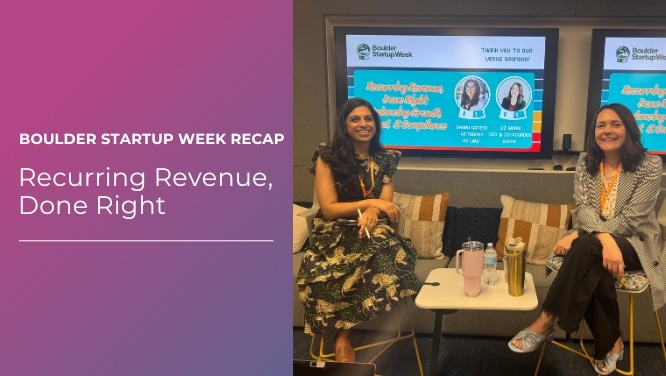
Recurring Revenue, Done Right: Balancing Growth, Trust & Compliance

- KO Firm
- |
- May 28, 2026
Subscriptions have long been treated as the holy grail of startup revenue—predictable, scalable, and attractive to investors. But as our recent Boulder Startup Week session made clear, the best subscription models don’t just drive growth—they strengthen customer relationships when built thoughtfully. In Recurring Revenue, Done Right, Charu Ganesh, attorney at KO Law, and Liz Giorgi, CEO & co-founder of our client soona, shared practical insights on how founders can create subscription experiences that foster long-term trust while supporting sustainable growth.
More than a legal discussion, the session was an open and tactical conversation about product strategy, pricing, customer experience, and the real-world considerations that come with launching recurring revenue models. Get a recap of the discussion below and, for more details, check out our Subscription Best Practices Checklist.
Strong UX and Compliance Often Go Hand in Hand
While user experience and legal compliance are distinct considerations, the discussion highlighted how thoughtful subscription design can support both. Regulators and consumers alike are increasingly focused on how subscription products operate in practice—whether pricing is clearly communicated, whether cancellation is straightforward, and whether the experience feels transparent.
Liz shared that soona prioritized clear disclosures around pricing, billing cadence, and cancellation even though they are not required to. Their goal was to build a transparent customer experience that fostered trust and reduced friction. That investment in clarity ultimately supported both stronger customer relationships and a more durable compliance posture.
Stress-Testing the Subscription Experience
When soona began testing its subscription model internally, Liz intentionally looked beyond enthusiastic early adopters. Instead, she focused on gathering feedback from people who were more skeptical or hesitant about the offering. Those conversations helped surface friction points early and ultimately strengthened the product and positioning.
That same approach shaped customer feedback as well. Soona relied on customer advisory boards that represented different types of users—from enterprise customers to SMBs, buyers—to day-to-day users. Combined with direct feedback loops and ongoing iteration around messaging, the company used real insights to refine both the subscription structure and the rollout strategy.
Messaging Matters More Than You Think
Introducing a subscription model after years without one requires thoughtful communication. Rather than quietly adding new fees or relying on overly polished messaging, soona chose to lead with transparency.
Liz communicated openly with customers about rising operational costs and positioned the subscription as an optional upgrade tied to meaningful additional value, including AI tools, integrations, and asset management features. Customers were also given the ability to opt out without penalty.
The broader lesson was clear: customers tend to respond well to honesty. Clear, direct communication often builds more trust than trying to present every business decision as perfect.
Make It Easy to Cancel (Seriously)
One of the more counterintuitive insights from the conversation was that making cancellation difficult rarely protects revenue in the long run. Instead, friction around cancellation often damages customer trust and creates frustration that can linger well beyond the subscription itself.
soona intentionally designed a straightforward cancellation experience. While some customers did leave, many later returned, customer service volume remained stable, and brand trust stayed intact. The conversation reinforced an important point: customers are more likely to come back when they leave on good terms.
“When somebody wants to stop using your service, the worst thing you can do is make them angry about it,” said Liz.
Subscription Fatigue Is Real
The session also acknowledged an increasingly common reality: not every customer wants a subscription. Rather than forcing a one-size-fits-all model, soona has both subscription and pay-per-use options.
Power users could benefit from recurring plans, while more occasional customers still had a way to engage with the product. Interestingly, that flexibility also became a pathway into subscriptions over time, as customers could experiment with one-off services before later upgrading into recurring plans. While investors often favor pure subscription metrics, the discussion highlighted how flexibility can sometimes support both customer acquisition and long-term retention.
Key Takeaways for Founders
For founders building or refining subscription models, the session offered a consistent theme throughout: sustainable recurring revenue comes from creating customer experiences rooted in transparency, flexibility, and trust.
Transparent pricing and intuitive cancellation flows are no longer just compliance considerations—they’re competitive advantages. Customer feedback is most valuable when it comes from skeptics as well as advocates. Flexible pricing structures can expand adoption rather than dilute revenue.
Above all, the conversation emphasized that successful subscriptions are not simply about maximizing recurring revenue. They’re about building products and customer relationships strong enough to earn recurring trust. Subscriptions, done right, aren’t just about recurring revenue—they’re about earning recurring trust.
If you’re building or changing a subscription offering—especially if you sell directly to consumers—it’s worth looping in legal early. And even if your subscription has been in market for a while, it’s never too late to tighten things up to reduce risk as regulatory requirements and customer expectations evolve. Upfront guidance can help you design pricing, renewal terms, disclosures, and cancellation flows that align with applicable compliance standards while still supporting a great customer experience and sustainable growth. Charu works with clients across SaaS, consumer goods, and professional services to design and refine subscription models that strike that balance.
For more details, check out our Subscription Best Practices Checklist and contact Charu Ganesh.